
A STRATEGIC CALL TO ACTION FOR INSTITUTIONAL LEADERS
Executive Summary
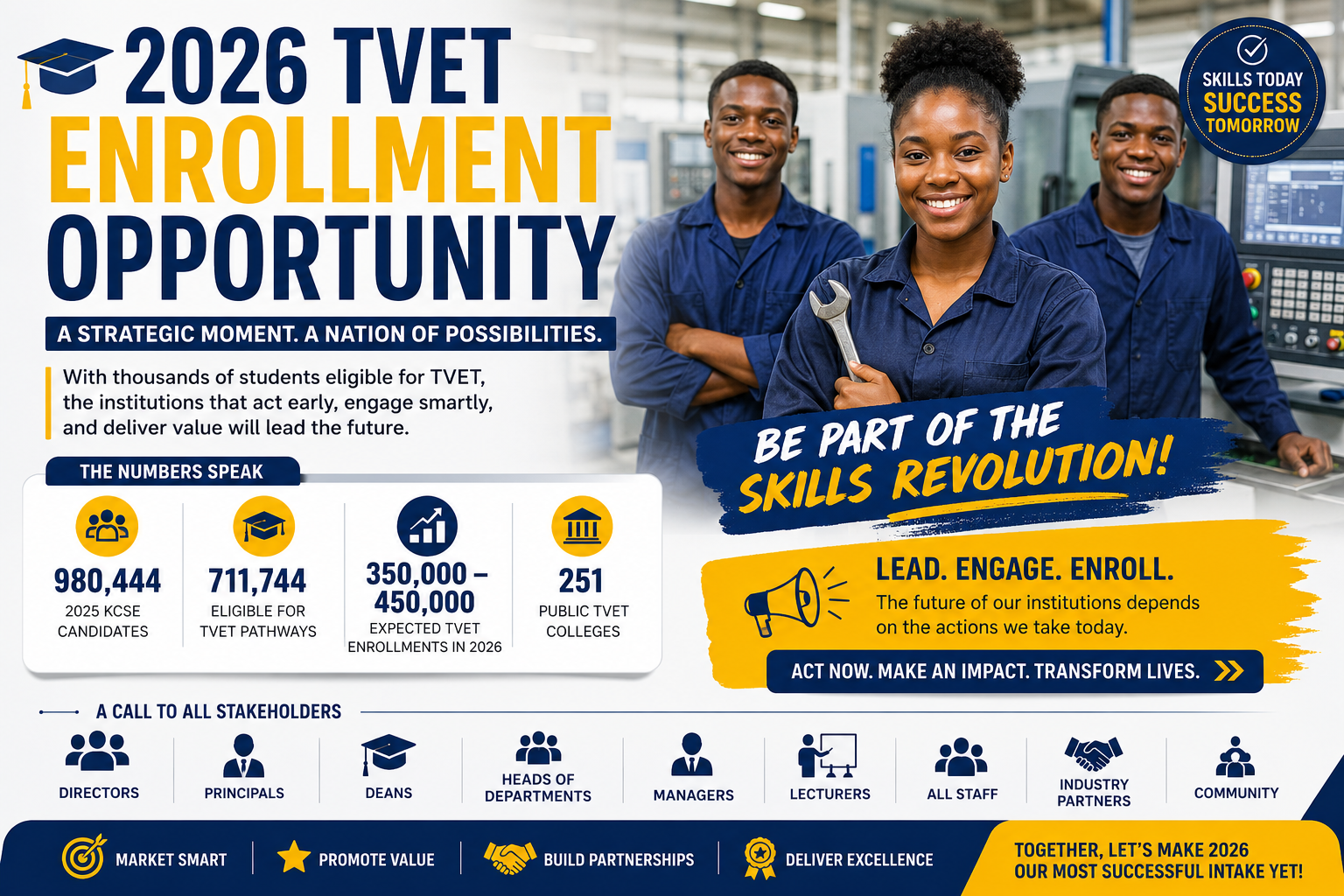
Kenya's 2026 TVET admission cycle presents one of the largest enrollment opportunities in the history of technical and vocational education. With approximately 980,444 KCSE candidates having sat the 2025 examination and an estimated 711,744 candidates eligible for TVET pathways, institutions across the country have a unique opportunity to significantly increase enrollment, strengthen workforce development, and advance the national agenda for skills-based education.
Current projections indicate that between 350,000 and 450,000 students are likely to enroll in TVET institutions during the 2026 intake cycle. This represents a substantial market of prospective learners seeking practical, employable, and industry-relevant education.
The institutions that act early, market strategically, and align their programmes with labor market demands will secure the largest share of this enrollment.
The Strategic Importance of the 2026 Intake.
The Government of Kenya continues to prioritize TVET as a key driver of economic transformation, industrialization, and youth employment. The growing recognition of technical skills, competency-based education and training (CBET), and direct pathways to employment have enhanced the attractiveness of TVET institutions.
For institutional leaders, the 2026 intake is not merely an admissions exercise—it is a strategic growth opportunity.
Success in this intake will influence:
- -Institutional revenue generation*
- -Resource utilization*
- -Government funding allocations*
- -Industry partnerships*
- -Institutional reputation*
- -Programme sustainability*
- -Graduate employability outcomes*
Every available student represents an opportunity to transform lives while strengthening institutional performance.
What the Numbers Mean
Estimated TVET-eligible KCSE candidates: 711,744
Projected TVET enrollment:
- -Conservative scenario: 249,000 students*
- -Moderate scenario: 356,000 students*
- -High uptake scenario: 463,000 students*
The competition for these students has already begun.
Institutions that rely solely on KUCCPS placement will likely underperform compared to institutions implementing aggressive recruitment and retention strategies.
Key Responsibilities for Institutional Leaders.
Directors and Governing Councils.
Directors must provide strategic leadership and ensure enrollment growth becomes an institutional priority.
Key Actions: -Approve enrollment growth targets -Allocate marketing budgets. -Strengthen industry partnerships. -Monitor weekly recruitment performance. -Support digital transformation initiatives. -Expand market-responsive programmes.
Leadership visibility and commitment are critical to enrollment success.
Principals and Deputy Principals
Principals must champion enrollment efforts across all departments.
Key Actions:
- Establish intake taskforces.
- Conduct weekly enrollment reviews.
- Engage county governments.
- Lead outreach campaigns.
- Mobilize alumni ambassadors.
- Build relationships with secondary schools.
The principal must become the chief enrollment ambassador of the institution.
Deans of Faculties
Faculty leadership directly influences programme attractiveness.
Key Actions:
- -Review programme relevance.
- -Update promotional materials.
- -Highlight employability outcomes.
- -Showcase industry certifications.
- -Organize programme exhibitions and demonstrations.
Students enroll in programmes, not institutions alone. Faculties must sell the value of their training opportunities.
Heads of Departments
Departments represent the frontline recruitment units.
Key Actions:
- -Visit secondary schools.
- -Conduct career guidance sessions.
- -Develop departmental recruitment plans.
- -Engage local communities.
- -Leverage successful alumni stories.
- -Promote attachment and internship opportunities.
Each department should have measurable enrollment targets.
Marketing and Admissions Teams
Marketing teams must move beyond traditional approaches.
Key Actions:
- -Intensify social media campaigns.
- -Utilize WhatsApp marketing.
- -Create student success videos.
- -Run digital advertising campaigns.
- -Improve website visibility.
- -Respond quickly to inquiries.
The institution that responds first often wins the student.
Strategies for Achieving High Enrollment Numbers
1. School Outreach Programs
Every institution should create a structured school engagement strategy.
Activities include:
- -Career talks
- -Skills demonstrations
- -Student mentorship
- -Parent engagement forums
- -Open days
Target schools within a 100-kilometer radius before expanding nationally.
2. Digital Recruitment Excellence
Today's students search online before making enrollment decisions.
Institutions should:
- -Maintain active Facebook pages.
- -Use TikTok and Instagram effectively.
- -Publish student success stories.
- -Produce short programme videos.
- -Optimize institutional websites.
Digital visibility is no longer optional.
3. Promote Employability and Entrepreneurship
Students want careers.
Institutions must demonstrate:
- -Employment outcomes
- -Industry partnerships
- -Internship opportunities
- -Business incubation support
- -Entrepreneurship success stories
The message should be clear:
"Training leads to opportunity."
4. Strengthen Industry Linkages
Industry partnerships create confidence among prospective students.
Actions:
- -Sign MoUs with employers.
- -Increase attachment opportunities.
- -Host employer engagement forums.
- -Invite industry experts to campus.
Industry endorsement significantly improves enrollment decisions.
5. Utilize Alumni as Recruitment Ambassadors
Successful graduates are powerful marketing assets.
Create:
- -Alumni testimonial videos
- -Success story campaigns
- -Community outreach ambassadors
- -Career mentorship programs
Prospective students trust former students more than advertisements.
6. Improve Student Experience
Enrollment growth depends on retention and reputation.
Institutions should focus on:
- -Quality customer service
- -Fast admissions processing
- -Clean learning environments
- -Modern training equipment
- -Student support services
Every student interaction influences future referrals.
7. Community-Based Recruitment
TVET institutions should become visible community development partners.
Strategies include:
- -County forums
- -Religious organizations
- -Youth groups
- -Community exhibitions
- -Local radio campaigns
Communities often influence enrollment decisions.
Performance Targets for 2026
Institutional leaders should establish measurable targets:
- -Number of inquiries received
- -Number of applications submitted
- -Number of students admitted
- -Conversion rate
- -Enrollment by department
- -Enrollment by county
- -Digital engagement metrics
What gets measured gets managed.
Call to Action
The 2026 intake presents a rare and significant opportunity for institutional growth.
Every director, principal, dean, head of department, registrar, admissions officer, lecturer, and support staff member has a role to play.
The institutions that begin recruiting early, market aggressively, engage communities, leverage digital platforms, and demonstrate clear employment outcomes will emerge as enrollment leaders.
Do not wait for students to find your institution.
Go where the students are.
-Visit schools.
-Engage parents.
-Mobilize alumni.
-Strengthen industry partnerships.
-Activate digital marketing.
-Track performance weekly.
-Act with urgency.
The race for the 2026 TVET student has already begun, and the winners will be the institutions that move fastest, innovate boldly, and execute consistently.
The opportunity is before us. The time to act is now.